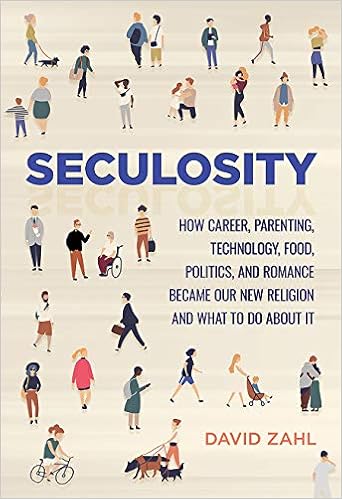
Seculosity: How Career, Parenting, Technology, Food, Politics, and Romance Became Our New Religion and What to Do about It
Being enough is a universal longing.
Seculosity makes the case that being religious is alive and well in modern society. While American organized religion may be declining, the desire to fill the void with everyday life pursuits is another form of worship. David Zahl describes his life as having one foot in the religious and secular worlds, a claim his biography justifies and states "the marketplace in replacement religion is booming." At the heart of our society lies a universal yearning not to be happy so much as to be enough. To fill the emptiness left by religion, humans look to all sorts of activities -- food, family, relationships, social media, elections, social justice movements -- for identity, purpose, and meaning once provided by organized religion.
In our striving, we chase a sense of enoughness. But it remains out of reach. Human effort and striving is causing burn out, depression, and anxiety. Even our leisure activities, such as dating and movie watching, become to-do list items and once accomplished we’ll hope to feel contentment with ourselves.
Seculosity takes a thoughtful yet light-hearted tour of "performancism" and its cousins. Performancism is "one of the hallmarks of seculosity," affecting how we approach everyday life. It cripples us with anxiety (Am I enough?), shame (Do they think I'm enough?), and guilt (Have I done enough?). Performance-based living while admirable will only leave us worn out because when is enough, enough?
Zahl challenges the conventional narrative of religious decline claiming society has become religious about busyness and accomplishments. Zahl unmasks the competing loyalties our lives revolve around in a way that is approachable, personal, and accurate. Eventually, Zahl brings readers to a fresh appreciation for grace -- the grace of God in all its countercultural wonder.
Reviews (97)

Organized religion is declining, but replacement religions are booming
American organized religion is declining. According to Gallup data, only 1 percent of U.S. adults claimed no religious affiliation in 1955. By 2017, that percentage had grown to 20. The younger the adult, the likelier the lack of religious affiliation. For adults ages 30 to 39, the percentage is 28; for those ages 21 to 29, it’s 33. If you’re looking for evidence of secularization in America, this rise of the “nones” is Exhibit A. Yet David Zahl claims in his new book that “the marketplace in replacement religion is booming.” Those replacements don’t look or feel religious, however — at least not in the capital-R sense of the term, which Zahl describes as “robes and kneeling and the Man Upstairs.” They don’t necessarily look like “folkloric beliefs” or “occult belief systems” either: things like charms, telepathy, or astrology. Instead, replacement religions center around everyday concerns such as — to list the topics of the book’s chapters — busyness, romance, parenting, technology, work, leisure, food, and politics. Zahl calls each of these replacements “seculosity,” a portmanteau of “secular” and “religiosity.” Seculosity is a religious impulse “directed horizontally rather than vertically, at earthly rather than heavenly objects.” Why does Zahl consider these secular concerns religious? And why should we? Those are fair questions, good ones even, because they go straight to the heart of what our culture thinks religion is. We typically think of religion in capital-R terms: organized religion with its concerns for doctrine, ritual, community and institutions. Those are outward manifestations of an inward impulse, which Zahl calls “the justifying story of our life.” According to him, religion is “what we lean on to tell us we’re okay, that our lives matter.” It is “our preferred guilt-management system.” In other words, religion is what “we rely on not just for meaning or hope but enoughness.” This search for enoughness characterizes religious “nones” just as much as it does the traditionally religious. It is a universal longing. Take the everyday concern about busyness, for example. Ask people how they’re doing, and they’ll probably reply, “Busy.” I certainly would. Between work, marriage, parenting and life in general, it feels like every moment of every day is accounted for … and then some. I tell myself to rest, but the moment I start to do so, the nagging suspicion takes hold that a book needs read, an article needs written, a chore needs accomplished, my kids need helicoptered over, my wife needs date-nighted, the latest blockbuster movie needs watched, etc. (Notice that even our leisure activities, such as dating and movie watching, become to-do items.) These nagging suspicions arise from what Zahl calls “performancism.” He writes: “Performancism turns life into a competition to be won (#winning) or a problem to be solved, as opposed to, say, a series of moments to be experienced or an adventure to relish. Performancism invests daily tasks with existential significance and turns even menial activities into measures of enoughness.” And woe betide those who fail at these tasks, because “if you are not doing enough, or doing enough well, you are not enough.” Zahl doesn’t quote Blaise Pascal at this point, but there’s a lot of wisdom in the latter’s statement, “All of humanity’s problems stem from man’s inability to sit quietly in a room alone.” (Now that I’ve quoted Pascal, I’m feeling guilty that I’m not checking off that to-do item either.) Performancism is “one of the hallmarks of all forms of seculosity,” their underlying assumption, affecting how we approach everyday life. It cripples seculosity’s practitioners with anxiety (Am I enough?), shame (Do they think I’m enough?), and guilt (Have I done enough?). “The common denominator [in all forms of seculosity] is the human heart, yours and mine,” Zahl explains. “Which is to say, the problem is sin.” In theological terms, you see, seculosity is just the latest example of a “religion of law.” It is a form of self-justification or works-righteousness. And like all such schemes, it is doomed to failure because “all have sinned and fall short of the glory of God” (Romans 3:23). We are not enough. We have not done enough. We cannot do enough. The antidote to seculosity is a “religion of grace,” Zahl concludes. “Sin is not something you can be talked out of (‘stop controlling everything!’) or coached through with the right wisdom. It is something from which you need to be saved.” That salvation depends on the sacrificial love of Christ. He is enough, and only in Him can you be enough.

The Best Kind of Cultural Criticism
Seculosity is not a traditional "Christian" book, but one that makes the case that the religious impulse is well and alive in a secular age. Despite the rise of "nones" and declining attendance at weekly worship services, Zahl articulates how the religious impulse hasn't gone away, it's simply resurfacing across a number of cultural institutions. I was familiar with the writing of David Zahl over at the Mockingbird blog (mbird.com), and really appreciated how the book format allowed him to expand in ways that the blog format could not. Zahl describes his life as having one foot in the religious and secular worlds, a claim his biography justifies. He is equally comfortable riffing off of a New Yorker thinkpiece, an 70's rock lyric, an anecdote from his years in college ministry at UVA, and the latest research in social science as he is the Christian bible. The result is a book that turns its gaze outside and inside the church, but doesn't see a lot of difference. Readers of Seculosity will enjoy top notch cultural commentary from a religious perspective on the matters that matter the most, with a self effacing dryness that is never condescending and first in line at the confessional. Highly recommended for those who want to understand the times we live in from an author who approaches both the world and the church with honesty and sympathy.

Oh. My. Gosh. No, seriously!
I am one of those annoying people who like to share as I read. I find sentences or paragraphs that resonate with me and post them on social media as I go through a book. Long before I reached the end of the introduction I already knew (from the solid yellow highlights) that this was going to be one of those books where, following my regular pattern, I would be posting the entire book, give or take a stray word or two. David's down-to-earth way of putting into words what we all know to be true about religion (both big and little r), worship, enough-ness, self-justification, etc., but just hadn't been able to express, is so satisfying! I found myself gratefully and humbly exclaiming, "Yes!" on every page. My 5 star rating doesn't begin to say how highly I recommend this book! Sincerely, everyone needs to read it. I know I'm gushing here, embarrassingly, but I don't care. It's that good.

One thing really bothered me...
When he is talking about the seculosity of something, entertainment perhaps, he talks about a man who cheated in his attempts to be the highest scorer of a video game. The author inserts a footnote here saying that it made him "crack a smile" when he read that the man had been caught and stripped of his accolades. Schadenfreude, that is, taking pleasure in someone else's misfortune, does not befit a Christian. Rather, we might have compassion for the person who fell into the trap of of putting performance up on the altar, who got so lost in thinking that a high score would fill the empty place in him that only God can fill. Hate the sin and love the sinner, remember? Overall the book is okay; I would have liked less description of seculosity—that can be explained in a few paragraphs in every case—and more focus given to the spiritual antidotes, the way we drill down through this morass of consumeristic culture we live in, so that we can find and fight for what really matters. It's good to raise the topic; we just need to go deeper, I think.

Looking for “enoughness” in all the wrong places
“It sounds like a Portlandia sketch, but is empirically true: the religious impulse is easier to rebrand than existing using,” David Zahl asserts in the introduction and then makes the case well in looking at how busyness, romance, parenting, and even food and leisure become the justifying story of our lives. The idea is this: we feel (know) that we are not enough and so we use these things that are necessary and even good in right proportion and seek “not just meaning or hope but enoughness” and then we find we can still fall short as we can never be enough. Along the way, he shows how we can take something good, like eating well and exercising but then build ladders and create scorecards and find ourselves not measuring up. Zahl’s argument is compelling and I hate to cut to the chase, but he does manage to point to a healthier way once he shows how the church becomes yet another obstacle in both its conservative (all about my salvation and personal holiness) and liberal (all about systemic issues and societal ills) emphases or guises. Spoiler: The answer comes in the grace-centered approach of recovery programs that start with failure and the certainty that “Everyone you meet is in some kind of pain, a swimmer in a riptide, sometimes of their own making.” Zahl is a good writer working through an important insight from a variety of perspectives and you will want to read the book rather than relying on this review. Better yet, read it with others and I bet the conversations about the ways we try to be enough will be funny as well as healing and helpful.

Exploring 'satis'
Why is nothing that we do ever 'enough,' either for ourselves, or for those in our lives? And why do we have to be so tired all the time? Seculosity makes the case that no matter the distraction or end-goal, life's expectations are crushing, and their elusiveness has everything to do with religion. Dave Zahl is a fully-cultured, full-hearted sociologist for these distracted times. The pages, while timeless, also fly, as Zahl's storytelling weaves seamlessly earnest and jocular.

There's a Bob Dylan Song About This
We're all chasing after "enoughness." This book's thesis seems self-evident to me, but my experience writing on similar topics enables me to report the idea is controversial, and even viewed as bizarrely novel but some people. Zahl claims the religious impulse in not limited to an oddball minority; it's universal. Everybody is in the business of setting up idols and sacrificing to them. (Cue Bob Dylan: "ya gotta serve somebody.") Zahl doesn't state it quite so baldly, but the warning of the book is that if these idols are false, their worshipers will suffer. The cruel idols of this age are in the book's subtitle. They make demands of us and what we offer them is never enough. I've been listening to the Zahls and their podcasts for years, and yet I found this book full of fresh warnings that are like wake-up slaps to my face. It's because what the author describes, a slavish service to the Sisyphean pursuit of "enoughness", is so sneaky, so pernicious. It's a trap anyone can find themselves swan-diving into. That's why this generation (any generation) needs the warning of this book.

This author really cares about people!
I really enjoyed reading this book and was able to finish it in one evening. My favorite chapters were the ones on Romance and Work (although I liked them all!) David Zahl is a very clear communicator and his illustrations are accessible and interesting for anyone living in our current culture. What struck me most about this book is the tone of Grace and understanding that runs through it. It is apparent throughout the entire book that the author cares deeply about people. I also thought that the self disclosure in the book was appropriate and helps the reader to connect with the author.

Convicting and full of hope
One of the best books on the ills of 21st century America that I’ve read - an eloquent, readable, convicting diagnosis of what’s getting us down these days. David Zahl posits that, contrary to the evidence from church attendance polls, we Americans are just as religious as ever. Human nature fundamentally seeks a source of hope, purpose, and most of all enoughness,, and even as “big R” Religion has seemingly begun to fade, other contenders have stepped in to meet our need for “small r” religion, or “that which we rely on not just for meaning or hope but enoughness” (p. xiv). This "seculosity" - defined as "religiosity that's directed horizontally rather than vertically" (p. xxi) - is at work all over. Whether we turn to work, romance, politics, or parenting to validate our existence, we have all set before ourselves some sort of scorecard for life, hoping that if we can just check enough boxes, we'll have done enough to satisfy that existential longing. Zahl shines a light on a few of the ways seculosity pervades our culture - in busyness, romance, parenting, technology, work, leisure, food, politics, and "Jesusland" (since the church is far from immune from these impulses!). In each chapter, he highlights with good humor but pointed accuracy the ways in which these aspects of our lives - all good in themselves - have morphed into cults offering false promises of peace, perfection, and belonging. Possibly the true success of this book lies in the fact that it reads like a fresh, innovative take on society and why we’re miserable, but truly breaks no new ground. Behind the references to Harambe and Seinfeld, Zahl’s writing shimmers with echoes of Christian thinkers from Augustine to C.S. Lewis. He strips away conventional religious terminology and provides new vocabulary and a framework to help us see ourselves and the spiritual condition of our culture with fresh eyes. He lays bare the ways our 21st century obsessions are merely the newest iteration of the age-old human condition, and then points us back to the cross as the only way out of the hamster wheel of works righteousness. Highly recommend to anyone feeling burned out by life.

A true must-read!
Zahl delivers a provocative and humorous perspective on the pantheon of secular religions to which we all (Christians and religious "nones" alike) sacrifice enormous amounts of social and emotional energy in order to find identity, community, and distraction. And yet, not one can provide any lasting peace. This is an important and accessible book which draws upon some of the seminal works of modern philosophy, psychology, and sociology (Alain de Botton, Jonathan Haidt, Charles Taylor, Daniel Kahneman, and many others) along with a deep well of theological and pastoral insight. Cannot recommend this book highly enough, and also Zahl and company's more regular writings/podcasts/publications over at mbird.com.


Comments
Post a Comment